Welcome to the Empathic Autistic Community!
| |

Hello and welcome! I just received an email from a young newly-identified autistic man* who was looking for resources, and I realized that I need more pages devoted to resources on my site! *I use identify-first language (for instance, autistic man) for most disabilities, including my own, and it’s an intentional choice. Before you prepare a person-first lecture, see the note at the bottom of this … Read More
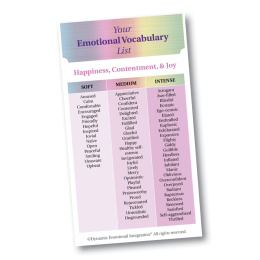

Emotional Vocabulary Lists
|

Your vocabulary matters!

Research is continually showing us that a good emotional vocabulary doesn’t simply help you identify more emotions – it also helps you work with them more easily, because you can quickly identify the type of emotion you feel, its intensity, and the reason you feel it.

[blockquote align="right"]

All by itself, a larger and more precise emotional vocabulary can help you learn to understand, regulate, and befriend your emotions!

[/blockquote]

This pocket-sized fold-out Emotional Vocabulary List contains alphabetized lists of words for nine different emotion categories with three differing levels of intensity.

Size: 3 inches by 5.5 inches.

Note: An earlier version of this list is included in the Art of Empathy Card Deck.

Autism, empathy, and the mind-blindness of everyday people
| |

Hello! I’ve completed graduate school, and I’m now Karla McLaren, M.Ed! My master’s degree is in education and curriculum design with a concentration in linguistic anthropology, and my focus is on autism, empathy, disability rights, and human rights. Over the next few months, I’m going to be posting pieces of my own research and the excellent research I’ve found. For instance, if you’d like to explore … Read More

Research-Based Approaches to Autistic Ways of Learning
|

Hello! I’m Karla McLaren, and in 2014 I completed my master’s degree in education and curriculum design (with a concentration in linguistic anthropology) at Sonoma State University in California. I focused on research-based suggestions for working with autistic children and adults in ways that support their neurology and their unique learning styles. *See this note about the identity-first language I use here. This is my master’s … Read More

The Six Essential Aspects of Empathy, Part 6: Perceptive Engagement
| |

Perceptive Engagement! Perceptive Engagement can be considered the pinnacle of your empathic skills, because it relies upon your first five aspects of empathy and helps you connect with others in truly supportive and workable ways. So far, we’ve looked at the first five of your Six Essential Aspects of Empathy. Today, we’ll look at the culminating aspect, which occurs when all of the aspects work together … Read More

Einfühlung and Empathy: What do they mean?
| |

Previously, we looked at the first of my six aspects of empathy, Emotion Contagion. We also talked about the importance of art for people whose Emotion Contagion skills are very strong (hyper-empathic people), and also for people whose skills are currently less developed. The good news is that the six essential aspects of empathy are changeable, malleable, and manageable throughout your life span; therefore, you can make … Read More

Autism Acceptance Month: Empathy in Action
| |

Dear Fellow Empaths, April is here with its promise of Spring, but this has also become a time that can cause a great deal of pain for many autistic people and parents of autistic children. Why? Because tomorrow (April 2nd) is Autism Awareness Day, and in many cases, the awareness focus is on alarmist rhetoric about epidemics and despair — and on finding a cure at … Read More

Empaths on the Autism Spectrum, part 1
| |

Can I do this job? In early 2006, I got a job working as an academic liaison for a group of 22 college-aged students on the Autism Spectrum. My job was to help the students with all of their academic needs: scheduling, counseling, learning accommodations, tutoring, social services, transportation … I was hired to create a total support system under and around the students so that … Read More

Is it real, or is it reified?
| |

We talked about the difference between imaginary things and imaginal things a few days ago, and about how important our imaginal capacities are. Basically, the difference between the two is that imaginal things are those that we create intentionally, whereas imaginary things (such as Easter Bunnies and optical illusions) are those that we don’t consciously choose. For me, imaginal things have intentionality behind them; they have … Read More

Imaginary or imaginal?
| |

Our site pal Mike Stumpf has asked me to explain the difference between imaginary and imaginal, because I mention our imaginal abilities in my book. It’s a good question, Mike! I think we all know what imaginary things are: they’re unreal things we might fear or wish for, like a bogey man or the Easter Bunny. We mostly know that these things aren’t real, but we can … Read More

1 8 9 10 11 12